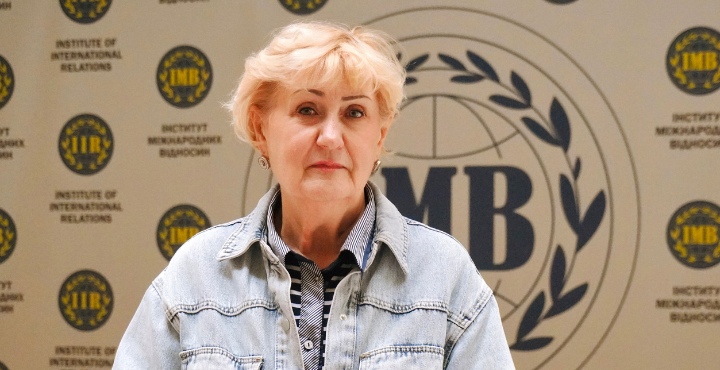
Interview with the Head of the Department of Foreign Languages, Professor Valentyna Daineko — on 50 years of the department, students, and a love for the profession
Which foreign language was the first to enter your life?
Back in sixth grade, for some reason, I decided that my life would be connected with the English language. To this day, I am unable to explain where that feeling came from. It was not that I had any particular fondness for English specifically — I simply approached all my subjects responsibly. Yet somewhere deep down, even then, there was a certainty that English was bound to become part of my life.
I also greatly wished to visit Iceland (laughs). That dream eventually came true — I managed to visit the country, and it truly amazed me.
How did you decide on your career path? Did you already know, back then, that you wanted to dedicate your life to foreign languages?
By the time it came to applying to university, I already knew I wanted to study foreign languages. I remember walking past the Red Building with my mother and telling her, "I want to study at this university."
What I wanted most was to enroll in the translation and interpreting department. But in those years, only male students were admitted there. So I enrolled in Romance-Germanic philology instead, studying French as my second foreign language. To this day, I can still read French and understand it quite well by ear, though I'm a little shy about speaking it. There was one occasion, however, when I got lost in the Paris metro and simply had to gather my courage and speak up (laughs).
And what I call my modest knowledge of French still comes in handy in my work today — particularly when I have to deal with international documents written in French and translate them into English.
This year marks 50 years since the founding of the Department of Foreign Languages. What was it like in the beginning, as you remember it?
The Department of Foreign Languages was established in 1976. Back then it was quite small — there were only about 14 of us on the faculty. We worked on the first floor of the KNU’s Yellow Building.
I remember 1991 very clearly — the declaration of Ukraine's independence, the referendum. And then, in 1992, we moved to what is now the Institute's building.
That was a new chapter. The premises had to be set up, and much of it was done practically from scratch. But there was something special about it — we were building the department's space ourselves. Little by little, everything came together, and that was how a new page in the department's history began.
What kind of impression did your first students leave on you?
We were extraordinarily fortunate with our students. They genuinely wanted to learn, and alongside them were professionals who were just as genuinely committed to giving them knowledge. I think that's precisely what allowed us to grow together.
The students were capable and motivated— many of them already stood out for their serious attitude toward their studies. They set a high bar, both for those who came after them and for us, the instructors.
When you became head of the department, how did you envision the language training of the Institute's students?
What mattered to me the most, was that we wouldn't simply teach students a foreign language, but continually refine the very approach to teaching it. We gave careful thought both to what we were teaching and to how we assessed students' knowledge.
No one spoke of the Bologna Process back then, yet we were already moving away from a traditional system in which the exam result decided everything. We began factoring in a student's work across the entire semester, adding it to the result of the final assessment.
Step by step, we also started reworking the curricula. Students were arriving at the Institute already proficient in a foreign language, and I realized that teaching it merely as a general subject was no longer enough. It had to become a tool for their future profession.
That was the point at which professionally oriented language training began to take shape. For me, what mattered most was that our graduates wouldn't just know a foreign language — they would use it with confidence in their profession.
What sets language training at the Institute of International Relations apart from conventional foreign language study?
Above all, at the Institute a language is never learned in a vacuum: from the very first day, it is woven into the student’s future profession. Our aim is not simply to give students a command of the language, but to teach them to put it to work in a professional setting.
Students begin with the fundamentals, yet the vocabulary of their chosen field starts to seep in as early as the first year. Even the textbooks for the junior courses are written with students’ specializations in mind.
The second year marks the beginning of systematic work on the language of the profession. By then, students have a first grounding in their field, a grasp of its core concepts, and a working familiarity with its terminology. What they encounter in their specialist courses gradually spills over into their language classes.
In short, we refuse to set language and specialization apart. Students deepen their professional knowledge and learn to express it in a foreign language at the same time.
How did the Institute's language training opportunities develop over time?
Once we started focusing more on specialized professional language, it became obvious we needed materials built specifically for that purpose. There simply weren't any ready-made textbooks that reflected the particulars of our specialties. So we set out to write them ourselves.
A lot of students and graduates still remember our very first textbook, "English in International Documents and Diplomatic Correspondence," by its red cover. New editions followed over the years, and students still refer to one of them simply as "the burgundy one" (laughs).
In this way, we gradually built our own educational and methodological foundation. Language-learning opportunities expanded accordingly: students could take up a second foreign language, with a remarkably wide selection across different years — including Swedish, Greek, and others.
Language training was highly intensive, with students in certain years attending up to ten foreign-language classes per week.
What gave rise to the idea of having students work with international documents in their original language?
My reasoning was simple: students already study specialist subjects and the documents that go with them, so why not bring those same texts into the language classroom, in the language they were written in?
Take future lawyers, who cannot do without the 1969 Vienna Convention. If they work with it in their specialist courses, they should be able to read and understand it in the original. That is how international documents gradually became a cornerstone of our language training.
I have always stood by this approach. There were suggestions to simplify the programme, to drop the documents and replace them with other materials. But I was, and remain, convinced that for an international relations specialist, the ability to work with a document is not a matter of preference but of principle.
Looking back over the years, what has reshaped the teaching of foreign languages more than anything else?
Above all, the way we approach learning has itself changed. When I was a student, classical methods held sway. Today the possibilities are incomparably greater, thanks above all to modern technology.
Within seconds, you can find the information you need, translate a text, or receive a ready-made answer. This makes learning considerably easier, but I also see a certain risk in it: when the answer comes too easily, a person does not always travel the road to it on their own.
In my day, after a class you had to open the textbook, reread the rule, and work out how and why it worked. You arrived at understanding yourself, and that effort was an essential part of learning.
I am not against modern technology in the slightest. The question is how we use it. It should help us think, not think in our place. Knowledge takes root only when you work through the material yourself and make sense of it.
Передусім змінилися самі підходи до навчання. Коли навчалася я, переважали класичні методи. Сьогодні можливостей незрівнянно більше, передусім завдяки сучасним технологіям.
How would you describe today’s students?
They have certainly changed. Today’s students, as I see it, are more ambitious: they start working far earlier, are eager to test themselves in a profession sooner, and want to work out what they will do next.
It seems to me that young people now feel a pressing need to gain professional experience as early as possible and to picture where they will be once university is behind them.
Yes, they are different. But so were we. Generations change, circumstances change, and we, their teachers, change with them.
They are neither worse nor better. They are simply different.
What matters most to you in teaching, after all these years?
I have given my whole life to this work, and I still love it. I sometimes even say that at work, I’m at rest.
Of course, teaching can be physically demanding: you stand, you speak, you are constantly engaging with an audience. Yet the strain is only bodily. Inwardly, I find genuine calm in it, and when you love what you do, the whole profession feels different.
Whatever is happening in your life, the moment you step into the classroom, everything personal must stay outside the door. Your students are in front of you, and for that hour you owe them your full presence.
Perhaps this, too, is something one learns over the years: to walk into a classroom and leave everything superfluous at the threshold.
What qualities must a truly good teacher embody?
I believe that doing work you do not love, and for which you have no gift, is a kind of dishonesty toward yourself. A profession should bring you joy.
For a teacher, this matters all the more, because so much depends on you: how you present the material, whether you can spark interest in it, whether students will want to listen, to think, to ask questions.
In that sense, a teacher is a little like an actor. An audience sits before you, and your task is to captivate it. If you succeed, you have reached your students.
But for that, you must love your subject yourself. Students sense at once whether their teacher is genuinely fascinated by what he or she does.
Art is clearly close to your heart. Is there a painter whose work speaks to you most?
My favourite painter is Diego Velázquez. He is known above all as a portraitist, yet the work that moves me most is something else entirely: Old Woman Cooking Eggs.
The painting is more than four centuries old, and it still astonishes with its realism. You look at it and feel that the egg white is setting in the pan right before your eyes, so precisely has Velázquez captured the light, the texture, the smallest details.
Perhaps that is exactly what draws me to it: after all these centuries, the canvas still seems alive.
Beyond expertise and languages, what else makes a true international affairs professional?
I always tell my students: imagine you are working at an embassy. You have been invited to a diplomatic reception, an exhibition, a gallery opening. You must be able to keep a conversation going, and not only about politics or international affairs, but about art, literature, theatre, and film.
You do not need to know everything. Choose what genuinely interests you, whether a movement in art, a painter, a writer, a director, and explore it in depth. Let there be one subject you can speak about not in rehearsed phrases, but because it truly captivates you.
An international relations specialist is more than a store of professional knowledge and a command of languages. It is also a well-read mind, a broad outlook, a curiosity about the world, and the ability to find common ground with very different people. In the international arena, that is part of the profession too.
One of the department’s recent initiatives is the “International Relations and Translation” programme. Why did the need for such a programme arise now?
Today, as Ukraine moves toward European Union membership, the demand for highly qualified translators is growing sharply.
Training such specialists is precisely what our programme is built for. It brings together expertise in international relations and professional translator training, and it meets the requirements of the European Master’s in Translation (EMT) competence framework. The framework defines the full range of competences a modern translator needs, and takes into account how the profession is being reshaped by technology and by the changing demands of the market.
That is why it mattered to us to design a programme that would meet current European standards while giving students the knowledge and skills they need to work with confidence in an international environment.
When you look at the professionals of your department, what do you admire most?
Today the Department of Foreign Languages is the largest at the Institute, with more than sixty teaching staff. What matters to me is that this is not merely a big team, but a community of people who never stop learning themselves.
A language teacher cannot acquire knowledge once and consider the work done. Our colleagues are forever honing their language skills, undertaking professional placements, mastering new teaching methods, and keeping pace with a changing professional landscape.
And what matters most to me is that all of this ultimately returns to the student. Whatever a teacher learns, they carry into the classroom. Perhaps that is why, over all these years, we have always been able to take pride in the standard of our graduates’ language training.
A department is strong when its professionals are strong. And I am truly proud of my colleagues.
Looking ahead, what would you like the department to become?
I would like the department to keep growing without losing what has taken decades to build: its exacting standards of language training, and the conviction that, for an international relations specialist, a foreign language is not an accessory but part of the profession itself.
Above all, though, I dream of seeing more of our graduates come back to us as teachers. They know the Institute from within, understand its character, and have been shaped by this school themselves, so they are the ones who can hand its traditions on to the next generations of students.
Technologies, curricula and teaching methods will keep changing. Yet the future of the department rests, first and foremost, on the people who will guard its traditions and enrich them with something of their own.
Complete the sentence: “For an international relations specialist, a foreign language is…”
…far more than a professional tool. There is a well-known saying: you are as many times a person as the languages you speak. For an internationalist this rings especially true. Every new language opens a different culture and a different way of thinking, and lets you understand more deeply the people and countries you work with.
That is why I always tell my students: the more languages you know, the wider your world becomes.