The New Humanitarian Landscape and Contemporary Challenges: Oleksandr Vyshnyakov’s Successful Defence of His Thesis
The proliferation of conflicts and crises in today’s turbulent world is driving a constant rise in demand for humanitarian aid. Cuts in humanitarian funding, structural shifts and changes in donor priorities are shaping a new humanitarian landscape and ecosystem.
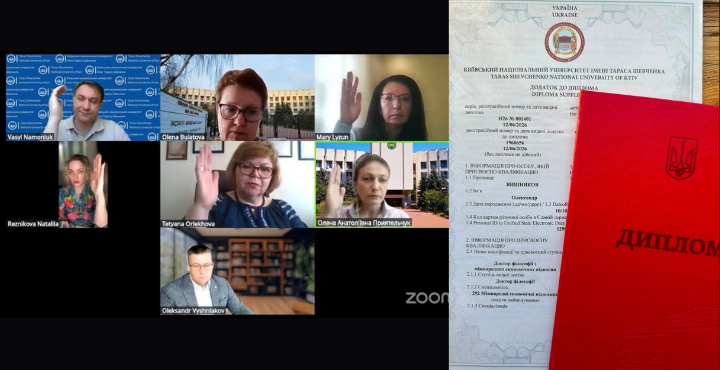
This topical issue is the subject of Oleksandr Vyshniakov’s doctoral thesis, entitled ‘The Formation of a Multi-Level System of International Humanitarian Aid in the Contemporary Context’, which he successfully defended before a specialist committee at Taras Shevchenko National University of Kyiv under the academic supervision of Professor Olena Bulatova.
The research topic also had a personal dimension, as Russia’s war against Ukraine has reduced the city of Mariupol – home to the professor’s academic school and with a population of half a million – to ruins. The city has suffered immeasurable human losses, tragedies and destruction – more than during the entire Second World War. Thousands of Mariupol residents have become internally displaced persons, in urgent need of assistance and protection.
Professor Olena Bulatova extends her sincere thanks to her colleagues for their creative collaboration, in-depth expertise, critical analysis and practical recommendations:
- the Chair of the Council – Olena Pryyatielchuk;
- the reviewers – Nataliia Reznikova and Vasyl Namoniuk;
- the external examiners – Tetiana Orekhova (Vasyl Stus Donetsk National University) and Maria Lyzun (Zaporizhzhia National University).
During the discussion and debate, it was demonstrated that the digital divide between countries not only restricts access to technology but also exacerbates further social stratification, which becomes particularly acute in the context of protracted humanitarian crises. This underscores the need to develop new aid instruments capable of ensuring inclusive economic growth and social resilience.
Research into such processes is of great importance for the development of effective strategies for human capital development in Ukraine in the context of a war economy and post-war reconstruction. Sincere congratulations to the PhD candidate and her supervisor on this significant academic achievement!