International scientific and practical conference "Shevchenko Spring"
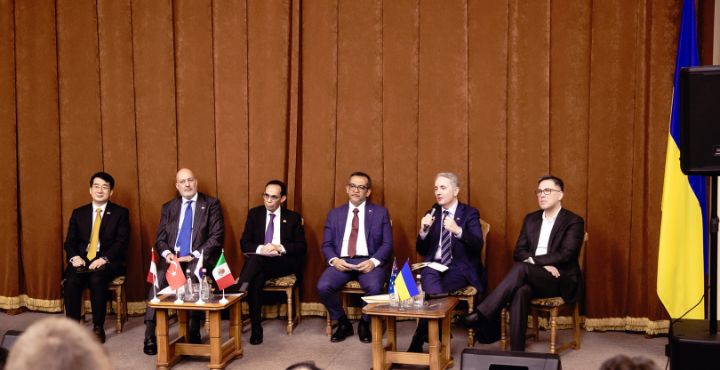
On April 2, 2026, the Educational and Scientific Institute of International Relations hosted a "Conversation with MIKTA Ambassadors," dedicated to the international scientific and practical conference "Shevchenko Spring".
At the beginning of the event, the guests and conference participants were welcomed by the Director of the Educational and Scientific Institute of International Relations, Professor Valerii Kopiika, and the Vice-Rector of Taras Shevchenko National University of Kyiv, Professor Kseniia Smirnova. The discussion was attended by Ambassadors Paul Lehmann (Australia), Audencio Contreras Gonzalez (Mexico), Arief Muhammad Basalamah (Indonesia), Park Ki-chang (Republic of Korea), and Levent Bilgen (Türkiye).
The meeting was moderated by Mykola Kapitonenko, Associate Professor of the Department of International Relations and Foreign Policy. Participants engaged in a productive discussion regarding the role of MIKTA in the contemporary system of international relations, particularly concerning support for multilateralism and international law. The discussion specifically focused on the lessons the association can draw from Ukraine's experience, as well as Ukraine's contribution to shaping the agenda for middle powers on the international stage.
During the discussion, students had the opportunity to ask questions and receive comprehensive answers from the Ambassadors regarding the role of MIKTA in fostering cooperation between developed and developing nations, as well as current trends in the development of international relations.
Following the official part, the international scientific and practical conference "Shevchenko Spring" continued its work in specialized sections, where young researchers presented the results of their studies.
This year, the event was organized jointly with partner universities: Friedrich-Alexander University of Erlangen-Nuremberg (Germany), the Polytechnic Institute of Lisbon (Portugal), the Norwegian University of Life Sciences (Norway), and Ivane Javakhishvili Tbilisi State University (Georgia).
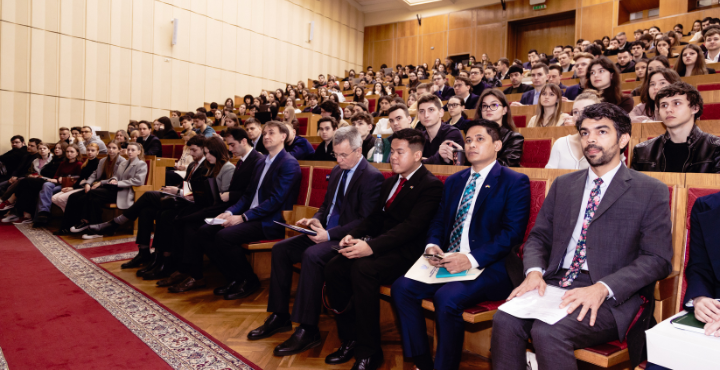
The conference brought together over 120 speakers from Ukraine and abroad, including Belgium, Norway, and Georgia, who worked across six sections.
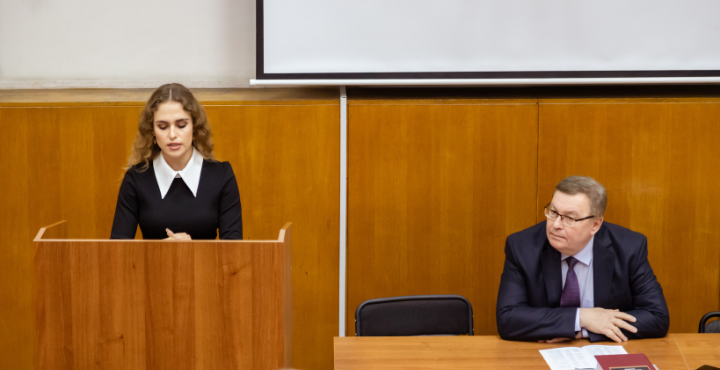
The "International Relations" section was moderated by Nataliia Pipchenko, Professor of the Department of International Information, and Serhii Makovskyi, Associate Professor of the Department of International Relations and Foreign Policy.
Within the "International Relations" section, two subsections operated: "Current Issues of International Security,"facilitated by the Department of International Regional Studies (moderator — Pavlo Ihnatiev, Professor of the Department of International Regional Studies), and "Modern Diplomatic Practices and Mechanisms of International Cooperation," organized by the Department of International Organizations and Diplomatic Service (moderator — Serhii Averianov, Assistant Professor at the Department of International Organizations and Diplomatic Service).
The "International Law" section (moderator — Associate Professor Viktor Kalakura, Head of the Department of Private International Law) included the work of the "Comparative and European Law" subsection, moderated by Professor Mykhailo Buromenskyi, Acting Head of the Department of Comparative and European Law.
The "International Economic Relations" section was moderated by Anton Filipenko and Denys Rusak, Professors of the Department of World Economy and International Economic Relations.
Key presentation themes included information and cognitive security, Ukraine's European integration, the international legal regulation of AI, global financial architecture, and security environment challenges in various regions of the world.
The Educational and Scientific Institute of International Relations serves as a traditional platform for discussions between foreign ambassadors and students, creating opportunities for open dialogue, exchange of opinions, and deliberation on pressing issues in international relations.
Events of this level foster a professional environment where students can interact directly with diplomats and practitioners, participating in discussions on global political issues.
The IIR combines thorough academic training with a practical component realized through the participation of the diplomatic corps. This contributes to the development of highly qualified specialists capable of working effectively in diplomacy, international law, international economic relations, foreign policy, and international communications within the public sector, international organizations, think tanks, and private companies alike.