Pysanka as a tool of Ukraine’s “soft power”!
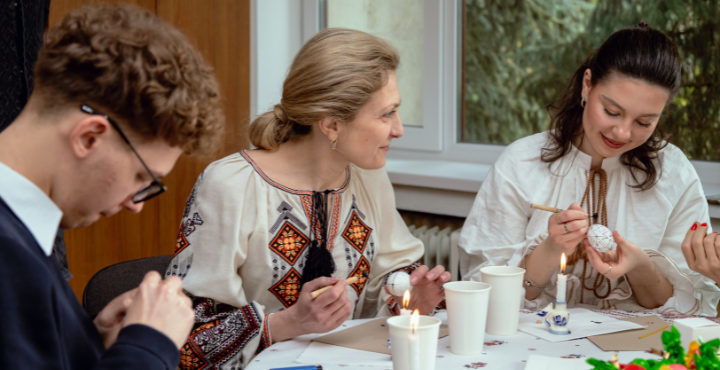
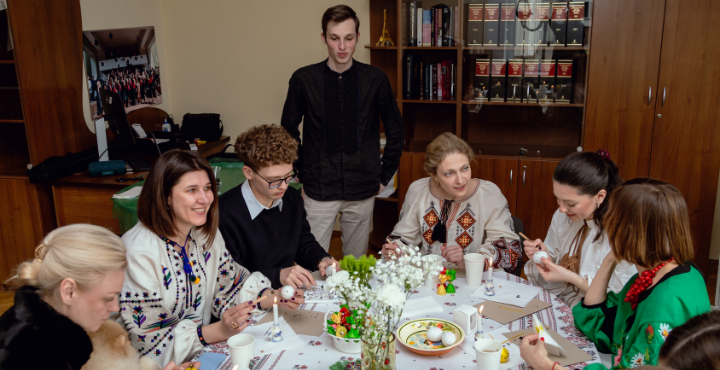
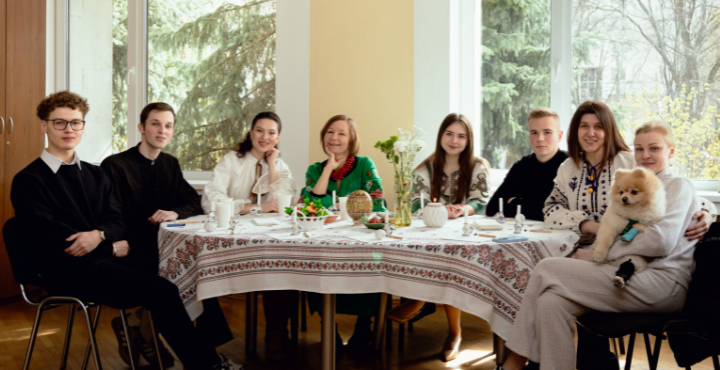
On the eve of Easter, at the Educational and Scientific Institute of International Relations, a student of the International Communications program, Oleksandr Kozak, held a pysanka-making workshop.
Participants experienced the true magic of creating a pysanka and had the opportunity not only to try the technique, but also to learn more about its symbolism.
In pre-Christian times, the egg was considered a symbol of life, rebirth, and the universe. Our Slavic ancestors believed that the world was born from an egg, and therefore attributed magical significance to it. In spring, when nature awakened, people decorated eggs with special symbols – such as the sun, waves, and plants. These symbols served as protective charms: they were meant to ward off evil, bring a good harvest, and ensure health. Such eggs were used in rituals, given as gifts, buried in the ground, or left in the fields for prosperity.
With the arrival of Christianity, particularly after the Baptism of Rus, the tradition did not disappear but instead gained new meaning. The egg became a symbol of the resurrection of Jesus Christ, and pysanka became part of Easter celebrations. Ancient pagan symbols were preserved, but reinterpreted: the sun came to represent God, the endless pattern symbolized eternal life and plant ornaments signified spiritual renewal.
In the Middle Ages, pysanka-making actively developed in villages. Each region of Ukraine formed its own distinctive ornaments, colors, and techniques. The process of decorating eggs was a whole ritual: pysanky were created in silence, with positive thoughts, sometimes even with prayer.
In the 19th and 20th centuries, pysanka-making became not only a folk tradition but also a subject of ethnographic research. However, during the Soviet period, this tradition partially declined due to the suppression of religious practices. Despite this, in many families the art of pysanka was passed down in secret – from generation to generation.
An important role was also played by the Ukrainian diaspora. Abroad, especially in Canada and the United States, Ukrainians continued to decorate pysanky openly. They established pysanka schools, published books, and even held workshops. This helped preserve the tradition at a time when it was partially declining in Ukraine.
At the end of the 20th century, after Ukraine gained independence, an active revival of pysanka-making began. Ethnographic research became the foundation for learning: old records, sketches, and collections were used to recreate authentic ornaments and techniques.
Today, the pysanka has become a tool of Ukraine’s “soft power”: through exhibitions, workshops, and cultural events, it represents Ukrainian identity to the world. Such initiatives help shape a positive image of the country, showcasing its history and culture without politics – through symbols that are easy to understand and remember.