Round Table “Dynamics of the Negotiation Process on Ukraine’s EU Membership”
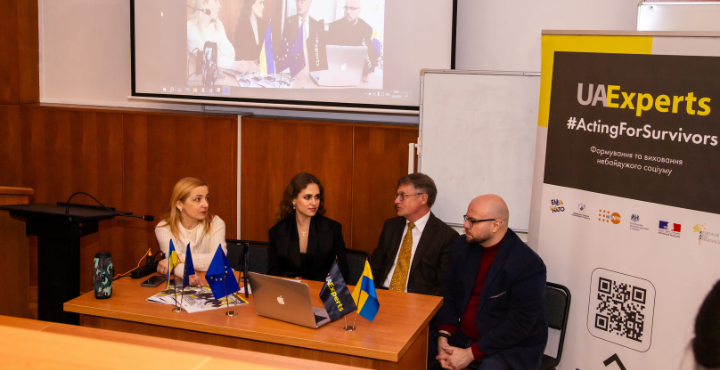
On March 18, 2026, a round table discussion titled “Dynamics of the Negotiation Process on Ukraine’s EU Membership” was held at the Educational and Scientific Institute of International Relations (IIR).
The event brought together representatives of public authorities, scholars, and experts in the field of European law and European integration.
The discussion featured the following speakers:
Maria Lazareva, Advisor to the Vice Prime Minister for European and Euro-Atlantic Integration, PhD student at the Department of Comparative and European Law of the IIR, with a presentation on “The Progress of the Negotiation Process on Ukraine’s EU Membership, Front-loading, Changes in the Enlargement Methodology”.
Bohdan Nedilko, PhD in International Law, State Expert of the Expert Group on European Integration and Policy Coordination of the Directorate for Strategic Planning and European Integration of the Ministry of Justice of Ukraine, with a presentation titled “Roadmap: Monitoring Its Implementation and Challenges”.
The round table was also attended by IIR faculty members and experts of the NGO “UA Experts”:
Olha Shpakovych, Professor of the Department of Comparative and European Law, academic expert of the NGO “UA Experts”, Head of the student research group “Law of International Organizations”;
Yaroslav Kostiuchenko, Attorney, Assistant at the Department of Comparative and European Law;
Oleksandr Biriukov, Professor of the Department of Private International Law, international expert.
During the event, special attention was paid to the Rule of Law Roadmap adopted by Ukraine on May 14, 2025, following bilateral meetings with the European Commission within the framework of negotiation chapters 23 “Judiciary and Fundamental Rights” and 24 “Justice, Freedom and Security”.
The Roadmap is a strategic document that defines the key reforms Ukraine must implement as part of the EU integration and negotiation process.
The Roadmap includes measures divided into four thematic blocks: judiciary, anti-corruption, fundamental rights, and justice, freedom and security. In total, the document provides for more than 500 measures covering judicial reform and judicial governance bodies, reform of the prosecution system, strengthening anti-corruption institutions, law enforcement agencies, corruption prevention measures, and the protection of fundamental rights.
Particular attention was also paid to the monitoring mechanism for the implementation of the Roadmap, which has three levels. The first level involves regular quarterly reporting by Ukraine to the European Commission. The second level is carried out within the negotiation groups for chapters 23 and 24 with the participation of public authorities, Members of Parliament, and civil society organizations. The third level involves the creation of thematic subgroups to address operational issues and ensure interagency coordination in the implementation of the Roadmap measures.
It was also noted that on December 11, 2025, following an informal meeting of Ministers for European Affairs in Lviv, a joint statement by the European Commissioner for Enlargement Marta Kos and the Deputy Prime Minister of Ukraine for European and Euro-Atlantic Integration Taras Kachka was published, identifying 10 reforms in the areas of rule of law and anti-corruption to be implemented by Ukraine in 2026. The Government of Ukraine has approved a relevant action plan for their implementation.
In addition, Ukraine received a list of interim benchmarks under negotiation chapters 23 and 24, which must be implemented in parallel with the Roadmap.
Among the main challenges identified were the significant volume of legislative work, the need to conduct a legal analysis of the EU acquis, and the need to coordinate positions among various public authorities. Another challenge is the continuous development of EU law, which requires the simultaneous implementation of both existing and new EU legal acts.
The event was organized by the Department of Comparative and European Law and the Department of Private International Law of the IIR with the support of the NGO “UA Experts”, the Legal Department of the IIR Student Council, the Bankruptcy Center of the IIR Business School of Taras Shevchenko National University of Kyiv, and the student research group “Law of International Organizations”.