A meeting with Akim Galimov ahead of the Day of Remembrance for the Victims of the Genocide of the Crimean Tatar People
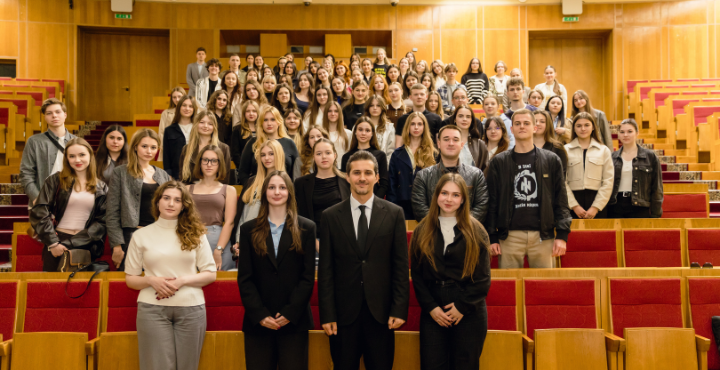
On the Day of Remembrance of the Victims of the Crimean Tatar Genocide, a meeting with journalist, documentary filmmaker, and author of historical projects Akim Galimov was held at Institute of Internationla Relations. The event was organized by the Institute’s Volunteer Department.
During the meeting the discussion focused on historical memory, Ukrainian agency, Crimean Tatar resistance and the role of culture in shaping national identity
Special attention was paid to tragedy of 1944 deportation of Crimean Tatar people, which was suppressed for decades by the Soviet authorities, while the Crimean Tatara themselves were deprived of the rights to speak about their own history.
“The whole nation was displaced in cattle cars to Middle Asia. Many people died on their way or in the first years after exile. However, the whole world at he time essentially remained silent” – emphisized Akim Galimov.
During the discussion, the journalist drew attention to the issue of Ukrainian agency, which is gaining particular importance today. In his opinion, it is precisely the struggle for one’s own history, culture, and identity that shapes the modern Ukrainian political nation.
“Today, Ukraine’s agency is being fought for by our military and the entire Ukrainian society. It is precisely this that compels the world to speak with Ukraine as an equal,” noted the speaker
The participants of meeting also discussed cultural identity in the context of globalization and the importance of culture as a factor of social resilience. Answering students’ questions, Akim Galimov emphasized that culture is one of the key factors that unite society and help it resist external influence.
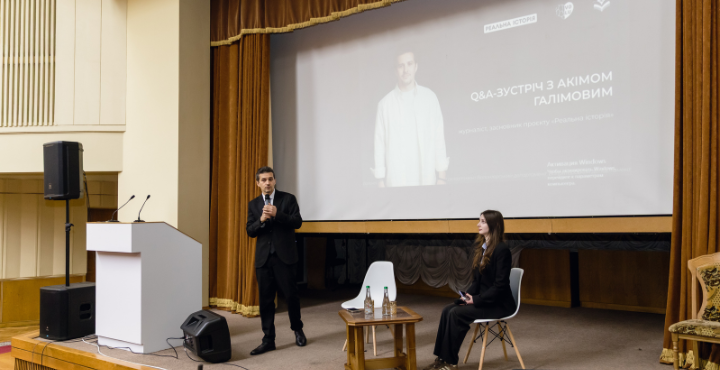
A separate focus of the discussion was the topic of Crimea and Crimean Tatar identity. The documentary filmmaker emphasized the importance of a deeper understanding of Crimean Tatar history within Ukrainian society and the need to integrate it into the broader all-Ukrainian historical narrative. According to him, during the Soviet period, Crimean Tatars were often portrayed through propagandistic clichés, while the topic of deportation remained suppressed for a long time.
During the discussion , the journalist emphasized that for decades Russia had deliberately shaped the perception of Ukraine as a part of its own space - and this influenced not only the West, but Ukrainians themselves.
In this context, Akim Galimov mentioned the Kyiv-Pechersk Lavra — a sacred and symbolic space of Ukrainian history, where imperial Russian markers had dominated for years, while Ukrainian history remained almost invisible.
“Cultural code – is a kind of vaccine against foreign propaganda. When we know our own history and culture, its much harder to impose something strange on us” - emphasized the documentary filmmaker.
The meeting became an important space for reflecting on shared history, the role of Crimean Tatar people in contemporary Ukraine and significance of culture as a ground for national resilience.